David Kittredge has a cold and about nine more such calls today, and he still lights up when I ask why anyone would spend years in a movie that’s been a punchline since 1977.
“I think that’s my favorite question and one that I’ll probably get asked all day today,” he says. Then he corrects the premise. “I didn’t choose him. He chose me.”
Boorman and the Devil is his documentary about John Boorman and Exorcist II: The Heretic, and it’s not the film you’d expect based on that description. There is no campaign of rehabilitation here, no argument that we were all wrong. Kittredge is looking for something harder to sell, which is true, making a spectacular public failure worth it.
The first interview unlocked it

Kittredge got his start in narrative filmmaking, and he says he resisted for a while precisely because he knew what he was getting into. “I know how much work documentaries are,” he says. “I was very reluctant to try to take on it because I knew that if I was going to do it, I would want to try to do something that really went beyond just making this film.”
What changed things was Boorman himself, who was the first to be interviewed. A day with the director in Ireland, a crew and a decision that Kittredge still seems a little surprised by. Boorman “made the decision to be open and vulnerable with me, in a way that he certainly didn’t need to be,” he says, “in talking about this film of his incredible body of work that I think is probably the least considered. But it’s also the film that changed the way he made films.”
This is the thing worth sitting down with. By Kittredge’s account, Boorman had barely discussed The Heretic for about forty years, mentioned it in passing, and moved on. It describes a filmmaker who almost quit, who spent about a year at home in Ireland teaching his young dyslexic son Charlie to read, and who did virtually nothing else. Excalibur arrived in 1981.
The argument that the documentary actually presents

I told him I’d rather watch an independent film with one real idea than a seventh Conjuring, and he agreed and immediately made it more interesting.
“I would rather see one film of any budget that takes real risks and maybe doesn’t even succeed all the time, or even most of the time, than ten films like that, they’re good,” he says. “You know, they’re just good. They’re fine. And you don’t think about it afterward.” He doesn’t mock skill. He says skill is no longer the reason he goes to the movies. “I need to see the ones taking big swings. And I don’t care if they connect or not. I want to see what the swings are.”
When I rebuffed the obvious business objection that no one funds a swing that doesn’t pay, he gave me the line the entire documentary clings to.
“You have to be able to risk an Exorcist II to get an Excalibur,” he says. “If you can’t take those risks in that sense, you’re not going to take any risks in any sense.”
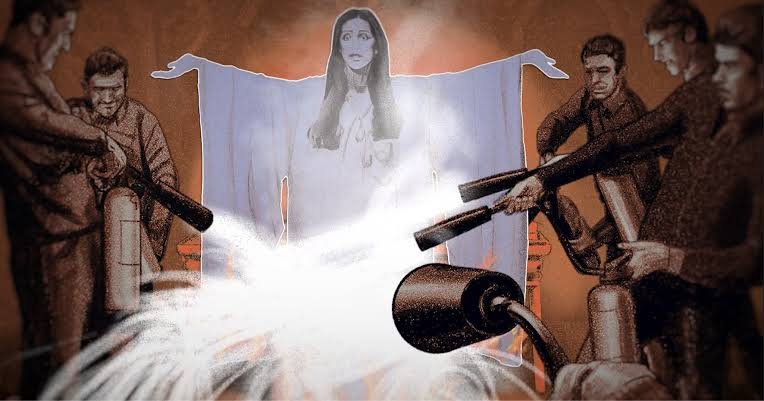
He means it literally, and the timeline supports him. Excalibur was the film Boorman directed next, and Kittredge points out that it was its own act of madness, compressing the entire Arthurian legend into a single film. He also says that Boorman took the toolbox forward, all the old-school tricks he had revived for The Heretic, front-projection glass and forced perspective among them, into a film where they finally worked.
Later, towards the end of our time, he extended the argument beyond Boorman. “Without Exorcist II, you won’t get Excaliburs. You won’t get Deliverances. You won’t get Point Blank. You have to be able to resist it.” Then, cheerfully: “The studios need to put on their big boy pants. I think the worst thing you can do in film is be careful.”
Why it didn’t work, according to him

Kittredge is not sentimental about the film’s reception. When asked if he was ever going to show up, he went straight to gender.
“I think there was a fundamental miscalculation regarding gender,” he says. The Exorcist, whatever William Friedkin wanted to call it, scares people. It’s literal, grounded, and character-driven. The Heretic is “more about ideas and images and sort of conveys a dream logic to the story.” His reasoning for why this combination fails is the most scathing film criticism in the conversation. A literal world is what allows the audience to accept a supernatural threat, he argues, because literalism is the ground one stands on while agreeing to believe the rest. Instead, build the foundations from metaphors and the danger stops registering as danger.
“Exorcist II: The Heretic is not really a horror film,” he says. “And that’s a problem when you’re making a sequel to one of the scariest films ever made.”
He is careful to note that Warner Bros. seemed to agree with this at the time. He quotes producer Richard Lederer as saying that the film wasn’t trying to scare the crap out of the original, and adds the obvious editorial: If you make a sequel and don’t try to make the original match what people came for, the problem starts there.
I wondered if the same film would fare better now, with an audience schooled in a decade of A24 and dream logic. He was less romantic than I expected. The film has real flaws, he says, and Boorman would be the first to admit that. What he thinks should be changed is not the audience but the marketing, and he immediately realizes how doomed this speech would be: he would have to spend the campaign telling people that this has nothing to do with the first film. “However you do this, the bar is high.”
Filming Wasn’t a Disaster, and That’s the Weird Part

The production story is where I expected the horror stories to be, and Kittredge partly refuses to tell them. Yes, filming was hectic. A production originally scheduled for January 1976 did not begin filming until May 24, with a release locked for summer 1977 because Warner Bros. had nothing else for this niche. About a third of the way in, Boorman caught Valley Fever, shutting down production for about a month. The schedule kept moving backwards until late 1976 and the mail was compressed.
But he didn’t want to get into the usual disaster scenario. “Despite everything that went wrong on that shoot, they had so many talented people and they did such incredible work that I almost didn’t want to put too much emphasis on, oh, it was a disaster,” he says. He describes a well-executed set under the direction of an experienced assistant director, Phil Rawlins, who died in 2009 and whom Kittredge says he wished he could interview.
The detail that really stings is the tests. Kittredge says he believes Boorman requested a test screening in Tucson and was denied on the grounds that it was the sequel to The Exorcist. The only screening of the film took place a few days before its release and went poorly. “I don’t think even the executives at Warner Brothers knew what they were sitting on until then.”
Louise Fletcher is the heart and he wants no credit for it

The emotional center of the documentary is Louise Fletcher, who died in 2022 and never saw the finished film, which Kittredge says breaks her heart. I told him that seemed like a deliberate structural choice. He wouldn’t accept it.
“I wish I could take credit for doing something to him,” he says. “It’s her.” He describes her as warm, open, funny and wise, and admits that he couldn’t cut her last story, about a spaghetti dinner, without crying. “I can’t take credit for making her the heart. She’s the heart. I just put her in there as she came.”
This impulse runs through the entire documentary, and it’s why the last section works. There’s a passage near the end where he flatly asks his subjects if Exorcist II: The Heretic is a good movie. He kept it on purpose.
“I didn’t want to interpret this as reclaiming this hidden gem,” he says. “It’s not about whether Exorcist II works or not. It’s about the fact that it should.”
Ask him what he wants people to do outside of the theater and he shrugs it off as the audience’s business, then lands in a better place anyway. He wants you to go watch Boorman. Point Blank, Deliverance, Excalibur, The Emerald Forest, The General, which he notes that almost no one has seen and which he calls a great film. And Zardoz, obviously.
Boorman and the Devil begins limited theatrical release on August 28, 2026.