Fifteen minutes later Yellow eyes I started keeping a list.
A young married couple inherits a crumbling house from an uncle they apparently barely knew. Somewhere in this house is a door with an eyeball painted on it. The husband begins to ignore his wife’s concerns almost as soon as she has them. There’s something old in the walls and it wants a body.
None of this is a slow build. This is a movie that runs through a checklist at a jogging pace, and it gets through most of the list before the end of the first act. By the time Jesse Korman’s debut arrives at the idea he actually wants to explore, he’s already spent the goodwill that comes from not knowing where a horror movie is going.
The couple is the good part

Here’s the frustrating thing. Performance is good.
Michael Kunicki and Nena Martins look great together. As Brad and Julia, they have real chemistry and enough specificity in their line readings to suggest two people with a history rather than two horror movie positions labeled Husband and Wife. There are passages early on where you can feel a different movie pressing against this one, the kind where marriage is the real subject and the demon is just what forces the conversation.
This version almost keeps happening. Then something shakes and the film remembers its obligations.
Possession by numbers

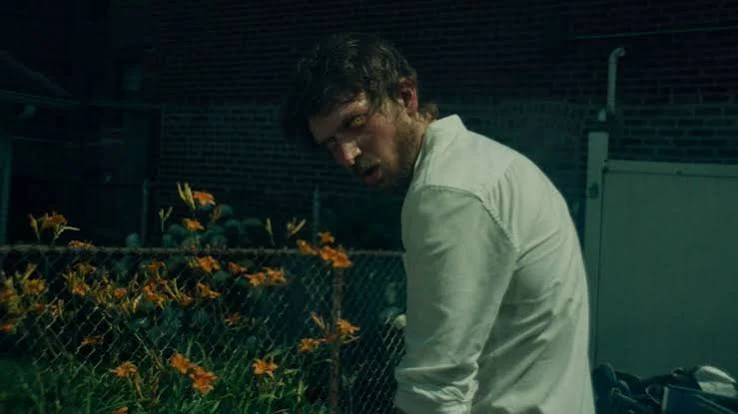
Once the idol starts working on Brad, Yellow eyes is committed to taking the form that the public already knows. He changes. She notices him. He denies it. The eyes turn yellow, black oil appears, and the distance between them widens as expected.
The individual beats are competently executed, and on this scale, that’s no small thing. The problem is that skill is all they are. A possession story lives on the specific texture of what the entity wants and how it achieves it, and Mickey Solis’ screenplay continues to trend toward the general version. An ancient force that feeds on humanity’s darkest desires is a premise with plenty of room. The film treats it as a reason for a man to become creepy rather than a reason to find out what this particular man wanted before anything got a hold of him.
The eyeball door is a good image. The same goes for an idol locked in a wall by a relative that no one in the family understood. Both are established early on and function primarily as signposts.
History of production

According to Big Picture Media, Jesse Korman shot the film in 12 days on a budget of approximately $150,000. This is his first feature film, produced by Joe Swanberg and Ben Gojer. Korman is also the lead singer of The Number Twelve Looks Like You, which is worth knowing when you think about where a person learns to create and release tension.
On a craft level, the money is on the screen. The house reads like a real place with real decadence. Performances are directed rather than simply captured. Nothing about Yellow eyes It feels like a filmmaker in over his head, which is the most common outcome for a first feature on this scale.
But a calendar is not an argument. A 12-day shoot explains why some things are simple. It doesn’t explain why the story goes exactly where you expect it to go. Structure is the cheapest thing to create in a film and the only thing that costs nothing but guts.
Verdict

Yellow eyeswhich began streaming on Screambox on August 18, is an accomplished low-budget debut with a cast capable of selling its supernatural melodrama. Its eagerness to adopt the familiar conventions of possession cinema is what prevents it from developing its own identity.
I will watch whatever Jesse Korman does next. I just wish he would make me wait a little longer to find out how it ends.