Found footage asks for one thing before it asks for something else. I think the camera was really there. Believe that someone was holding him, that the battery was a real problem, that no one in the frame knew he was in a movie. Night Terror honestly buys into that belief for long periods of time, then spends it on things she never needed to buy.
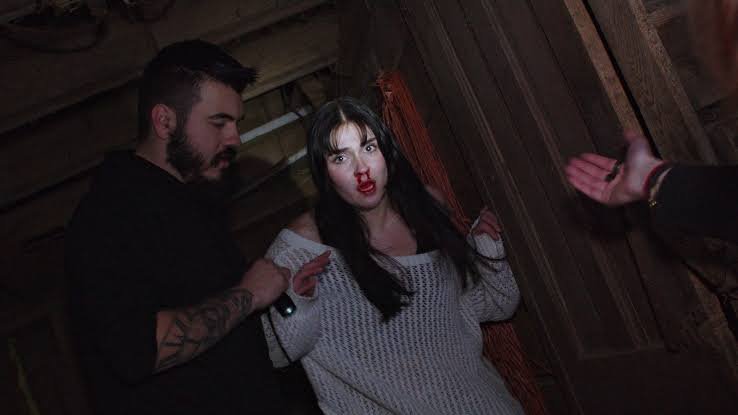
Night Terror was written by Joshua Brucker and co-directed by Brucker and Hunter Nino. Release of terrorist films streaming it on Tubi, Chilling, The Roku Channel, Fandango at Home and other platforms on September 4. Marleigh Arnold plays Shelly, a young woman living with sleep paralysis and night terrors, and two students decide that her condition would make a good documentary project. It’s a clean, mean little setup. That’s also not the only thing the film wants to do, and that’s where the trouble starts.
The house looks real

Most micro-budget horror films are shot in a borrowed house for a weekend. You can always find out. The counters are too light, the walls are too bare, someone moved the family photos into a closet so the frame is neutral. Night Terror doesn’t do that. The house in this film appears occupied. There’s stuff on the surfaces. The furniture does not match. The rooms look like rooms where people eat cereal and lose their keys.
This seems like a small compliment and it isn’t. Found images work with ordinary texture, because ordinary texture is the whole point. If the space feels like a set, every scary thing that happens there seems staged by association. Brucker and Nino give us a place that could plausibly be in someone’s real life, and the scares inherit that credibility for free.
There’s something there

It’s in the exterior work that this movie is really good, and I mean good without qualifiers.
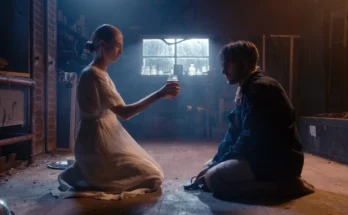
Once the camera comes out at night, the film remembers what it has. Darkness, light does not pass through. Trees that stop being decoration and start being cover. A visibility range of approximately five meters, beyond which the world is nothing more than a rumor. There are shapes. Sometimes they move. Sometimes you can’t be sure they moved and you rewind it in your head rather than on the remote, which is worse.
These sequences comprise the format’s oldest strength. The camera can’t show you everything, so your brain volunteers to fill in the rest, and your brain is not on your side. Whoever took these photos knew exactly what to hide.
When the illusion shatters

Credibility is buoyant here in a way it never is in conventional cinema, so the cracks are more visible. Shelly appears asleep in one sequence wearing what looks like full makeup. Little thing. In a normal movie you would never record it, because a normal movie already told you it was a movie. Here it lands differently. For a second, you’re not looking at a woman who can’t wake up, you’re looking at an actress who’s had her hair and makeup done, and the room around her becomes a place again. The film recovers. This shouldn’t have been necessary.
Too many stories, not enough scares

The biggest problem is that the film doesn’t believe its own premise is enough.
A woman. A condition that no one can film. A house. A camera. Anything beyond the tree line. It’s already a complete horror film, and Night Terror clocks it in twenty minutes. Then he continues adding. New threads arrive, new participants arrive, the official synopsis will tell you that a team of paranormal investigators will eventually arrive, and each addition asks you to shift your attention somewhere where the fear isn’t.
I’m not asking for more scares. Jump scares are the cheapest solution available and this movie doesn’t need to be cheap. Dread is a resource you spend or conserve, and each explanation expends some of it. These long, quiet passages could convey the entire picture if the film kept the pressure up through them. Instead, the pressure continues to be redistributed into the intrigue machines, and the intrigue machines have never made a dark courtyard more frightening.
The best moments come when no one explains anything. The camera is sitting. Something wrong. Nobody says what.
Luna’s Verdict
There is real capacity here. No promises, that’s the word people use to politely say that a film failed. Ability. An eye for what a cheap camera can and cannot see, the patience to stand at the tree line, the instinct to film in a house that looks like someone lives there. Brucker and Nino know what found footage is for. They’re less sure about how long a found footage movie can go between scary things, and they’re far too willing to answer questions that the format did well by leaving open.
Night Terror is at its best when it remembers that a shaky camera pointed at a dark patch of woods can be scarier than another subplot.
There is a better and scarier film watchable in Night Terror. Every time the film stops explaining itself and lets the house, the woods, and an imperfect camera do the work, you can understand exactly why Brucker and Nino wanted to make a found footage film in the first place.
Verdict: flow. September 4 on Tubi and everywhere else it lands. Watch it at night with the lights off, which is the only fair way to watch something shot in that darkness.