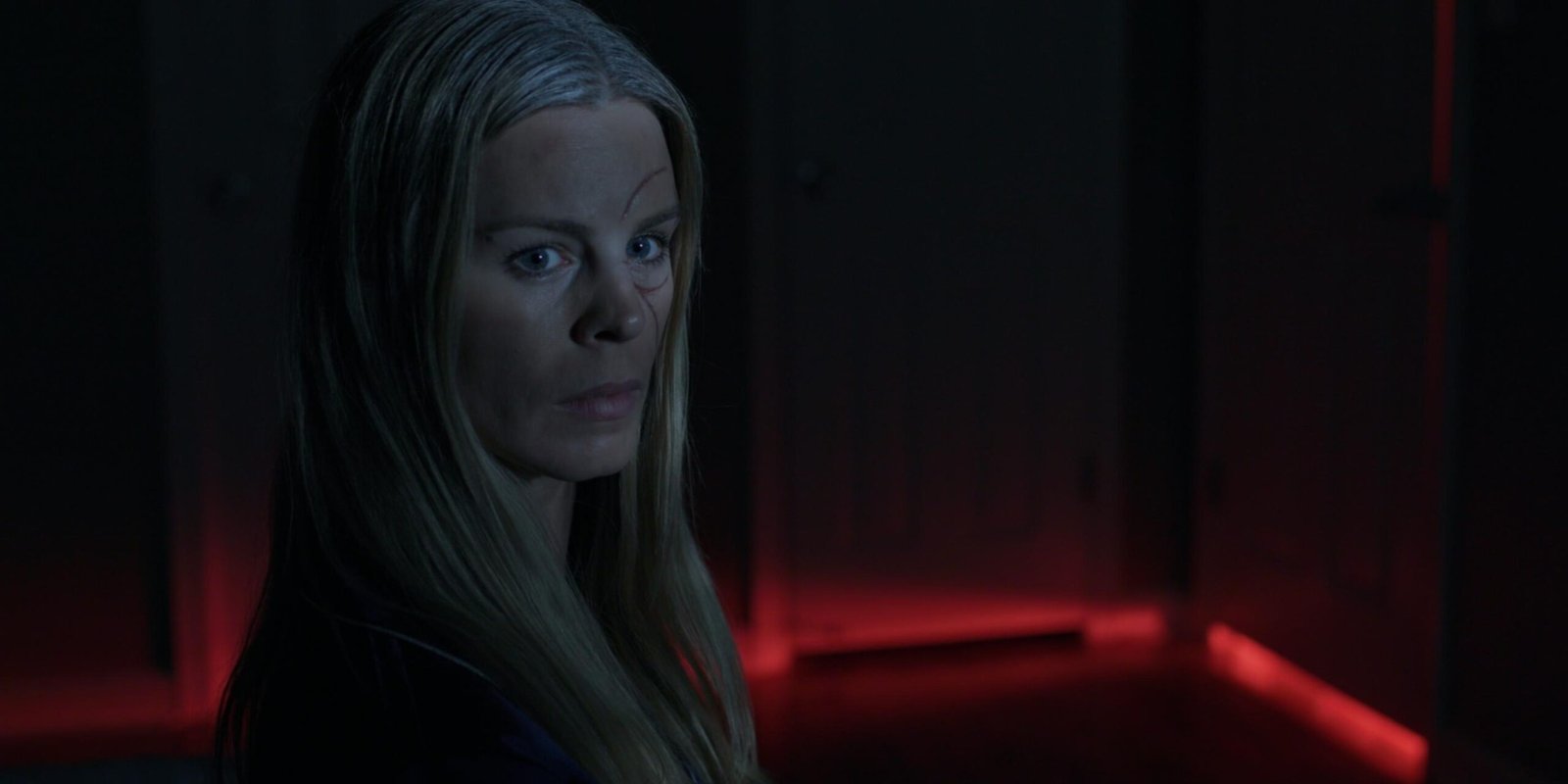
Madison Neubauer falls asleep in one life and wakes up in another. Five years disappear while she is unconscious, and the town she returns to has quietly rebuilt itself around a church that did not exist when it collapsed. Robert Hollocks, who directed The Observance and co-wrote it with Amy Rhinehart Bailey, didn’t go into a coma because it was convenient. He grabbed it because that leaves five years of change on a single person in a single morning.
“She’s been gone for five years and when she wakes up, it’s like no time has passed,” Hollocks told me. “It’s like the next day.” This gap runs through the entire film. This is also why The Observance works better as a study of manipulation than as a creature feature, because nothing supernatural chases Madison. People are.
Worship came first

Madison didn’t come first, and neither did the coma. “It really was a cult,” Hollocks said. “That was kind of the main reason.” The idea belonged to Bailey, who had spent years homeschooling in the South and, in his words, “met some very interesting people” along the way. She wanted to write about cults and how they manipulate people. Hollocks discovered a research hole that he now describes with some affection. “I was up to my head in cults by the time we finished our research.”
This search first appears in an opening sequence that behaves like the last ten minutes of another film. A priest runs into the woods. Masked hunters are getting closer. I told Hollocks it was played like a final, and he didn’t argue. “It’s almost like the James Bond thing where you drop someone off at the end of a previous story and you’re totally captivated by it,” he said. “The idea for me was to introduce the hunters, the people wearing jackal masks, and present them as villains from the beginning.” I want the prequel, and I said so. It turns out I’m not alone, as Hollocks and Bailey developed a story along the same lines, built around Jonas and Athaliah, the architects of the cult. “They’re these kind of delightful villains that everyone loves to hate,” he said, describing a film about “how they went from pretty humble beginnings to leading this huge cult. That would be a cool story to tell someday.”
When belief becomes a weapon

The line that stuck with me was “God is fear,” said during a monologue near the end. I asked if that belonged to the character or the movie. Hollocks said both, then made an important distinction. “It’s definitely his personal theology. It’s what he believes,” he said. “It’s not supposed to be an anti-religious film.” The goal is narrower and more useful than that. “It’s more about how religion can be misused, misinterpreted and distorted to benefit individuals.”
The film earns this distinction by refusing to make Jonah, played by Alec James, a crook. Hollocks and his team debated it and landed in a more difficult place. “I thought it was a lot more interesting when you have someone who’s leading a cult and actually believes what he’s saying,” he said, “a lot scarier when he’s completely convinced and convinced that his direction and what he’s doing is absolutely the right path.” He is right, and the reason is structural. You can claim fraud. You cannot argue with a man who thinks he is saving you, because every objection you raise becomes more proof that you need to be saved.
Building compliance

The cult recruits like a business, which is the most troubling topic of the conversation. “They have a strategy of targeting people who are weak or who are going through some sort of emotional trauma,” Hollocks said, citing Gabriel Neubauer, Madison’s husband, as the clearest case in point. There is a property aspect beneath the theology, and there is a chemical aspect above it. “Once they come to the celebration and drink the wine and everything else, then they become addicted to it.” When I asked him to confirm that nothing paranormal was happening, he didn’t respond. “It’s all about manipulation and the psychology of manipulation.”
The physical film was constructed in the same way, from found objects and careful planning. Filmed around Augusta, Georgia, the production relied on a community that Hollocks describes as genuinely excited to have a crew around. The cabin is a real cabin. The church is a working wedding venue whose owners read the script, said yes anyway, and then appeared in the congregation scenes. He estimates that about eighty percent of what you see was found and twenty percent was dressed. “I always believe planning is everything,” he said. This is how the finale of the temple was filmed in a single night, between ten in the evening and three in the morning. Even the stylized slow-motion machete throw near the end, the one that had me sitting up because it borrowed so blatantly from The Matrix, was a deliberate reference rather than an accident, executed with a fake blade and a friend manipulating the composite.
⚠️ SPOILER WARNING
The next two sections deal with the fate of Ted Raimi’s character and the ending of the film.
Ted Raimi and the safety of familiar faces

Ted Raimi plays Richard Abernathy, and his presence in a cult indie horror film surprised me. The journey was not glamorous. Hollocks had a contact who had worked with Raimi, contacted his agent and sent him the script. Raimi read it, loved it and shot his part in about three days. Hollocks speaks warmly of the ease with which he was present, with no trailer requirements and no distancing from the crew.
Then he explains what the casting was really for. “We kind of wanted to do this whole Psycho thing where you bring in the main actor and then kill him off unexpectedly,” he said, pointing out his own spoiler as he went along. “He plays a good guy and he’s a great character, and it’s a shock when what happens to him happens.” It works exactly because of what I brought to the film as a viewer. I thought Raimi would survive until the finale. This is Ted Raimi. The film uses four decades of goodwill as a trapdoor.
Horror without happy ending

Madison survives. Almost nothing else does. She takes her daughter out and loses the husband, the property, and any clean version of life she has fallen asleep into. I asked if there was a sweeter ending. “It didn’t seem right to give him a completely happy ending,” Hollocks said. “It was one of those things where experiencing something like that could leave damage and scars.”
He was asked to reconsider his decision. Upon purchasing the film, he said: “A few of the people we talked to were wondering if you could have given it a happy ending. » His answer holds. “Yes, we could have, but I thought that would have been an escape from the story we were trying to tell.” Money wouldn’t have changed anything either. With a million dollars more, he would have bought an even worse death for Jonas, involving a stone structure over water that the budget couldn’t support, and nothing else. “I really like working with smaller budgets because it makes you more creative,” he said, and the careful, planned look of the film speaks in his favor.
What he wants to leave behind is not fear. “How easy it is to listen to the wrong person, to listen to lies, and to subvert truth and faith,” he said, before landing on the line, the film continues to roll. “It’s like Madison’s line in the movie says: How did you fall for it? Everyone would think I would never fall for it. But people do it every day.”