Possession films have spent over fifty years trying to extricate themselves from The Exorcist. Most of them just change victims, countries or decades. The priest always appears. Latin is still said. Steven Fierberg’s The Spirit Lock at least brings one different tool to the ritual, and for a while, that’s enough to make it feel like it might be going somewhere new.
The setup, written by Justin Stanley and Mark Jonathan Stanley, is intentionally familiar. Karl and Vanessa Mellor have a son whose behavior has become violent and frightening. Vanessa wants doctors. Karl goes looking for something older. What he returns with is the Spirit Lock, an ancient pagan object believed to retain or expel anything that has entered their child. The accompanying ritual does not make the house safer.
A different tool for an old job

The object is the best thing in the film. Swapping out the crucifix and holy water for a piece of pagan material that no one in the audience has seen before gives the film an immediate identity. It also raises questions that seem to genuinely interest the film, at least at first. Where does this thing come from? Who used it before this family. What happens to everything inside?
Then the movie stops asking. We know enough about the Spirit Lock to find it intriguing and not enough to find it memorable. The mythology remains a sketch. This is the central frustration, because as soon as a possession film invents its own rules, it takes on the obligation to explore them, and it keeps bringing the subject back to material that we have seen a hundred times.
The believer and the skeptic

The other good idea is belief creation. Usually, it’s the mother who insists that something wrong is happening while a man tells her to calm down and call a specialist. Fierberg returns it. Karl is the parent who becomes certain of the supernatural. Vanessa is the one waiting for a diagnosis and a treatment plan.
This reversal buys real ambiguity from the first act and portends a truly unsettling film about a frightened father whose certainty becomes its own danger. If you believe that an entity took your son, then everything you do to the boy is done to the entity. It’s a horrible thought and the film pushes against it more than once. He never really commits to it either.
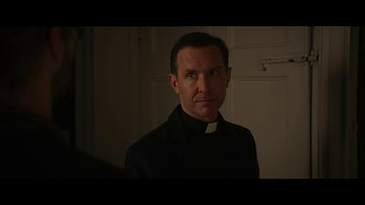
Joe Anderson and Yasmin Al-Khudhairi do the heavy lifting and they are good enough to keep the film on its feet. Anderson keeps Karl closer to exhaustion than zeal, which is the right instinct for a man short of other explanations. Al-Khudhairi gives Vanessa something better than the standard skeptical spouse, a woman short of arguments and self-aware of her condition. The marriage crumbling under the strain is as much the driving force of the film as what happens in the boy’s bedroom. Stefanos Paraskevopoulos has the thankless task of playing Kit across multiple registers and mostly succeeds. Tim Downie appears as Father Bailey and does what the role needs.
The house deserves its place

Most of the runtime takes place in the family’s rural home, and Fierberg squeezes decent value out of this limitation. Isolation does what isolation is supposed to do in these movies. Nobody comes. Help is a long drive away. The film is at its strongest in the moments where it embraces uncertainty and leaves the house feeling bad, and at its weakest when it reaches for the familiar imagery of a possessed child. We’ve all seen a child’s body used as a special effect. We haven’t seen the Spirit Lock.
Where he retires

After about eighty-five minutes it should move, and some parts do. Other sequences feel oddly slow, mostly because conventional possession beats get more screen time than the ideas that set the film apart. The pacing sags in the middle and a few scenes end before they’ve finished doing their job while others rise above the tension they’ve created. A tighter edit with more room for mythology would be a significantly better film.
None of this makes it a failure. The Spirit Lock has a real idea and a cast that sells the human half of it, which is more than many low-budget possession films can claim. The disappointment is seeing this idea share a film with a much safer film and lose.
If you’re out of exorcism movies, this is worth eighty-five minutes of your evening. I only wish the film was half as curious as I was about what was inside the box.
The Spirit Lock is available on UK digital from September 7 from Seven Tales.
Verdict

3/5. A flawed but worthwhile British possession film whose pagan hook makes it more interesting than its execution, and whose best ideas deserve a bolder film than the one built around them.